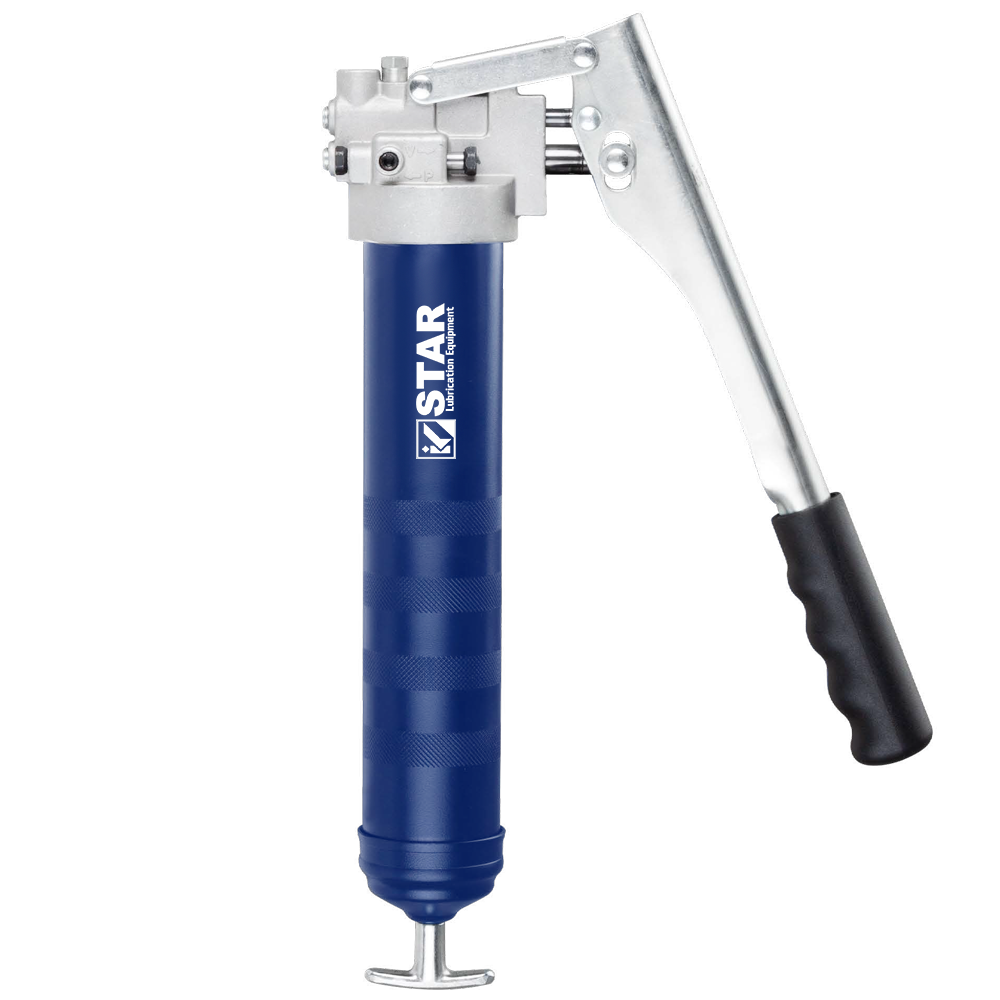

S-741 Lever Action Grease Gun
The STAR S-741 Switch Model Lever Action Grease Gun is the dual-mode HP/HV grease gun in the STAR range, where HP = High Pressure and HV = High Volume: a single lever-action unit with a slide-button mechanical switch that lets the operator select between High Pressure (HP) mode at 12,000 PSI (830 bar) for clogged or stubborn fittings, and High Volume (HV) mode at 2,000 PSI (130 bar) for fast fleet-service and large-bearing filling. HP mode delivers 0.6 g per stroke (1 oz. per 47 strokes) for concentrated pressure on blocked or crusted zerks; HV mode delivers 3.2 g per stroke (1 oz. per 10 strokes) for approximately 5X the throughput on open-access multi-point greasing routes. The S-741 replaces two separate grease guns (one HP, one HV) in a single professional-grade unit.
We at STAR engineer the S-741 for professionals whose daily greasing workflow spans both ends of the pressure-volume spectrum: heavy-equipment fleet workshops servicing both clogged fittings and large open-access bearings in the same shift, industrial plant maintenance teams covering stubborn plant-machinery zerks and high-volume conveyor-line service on the same route, construction-equipment service centres, and amusement park and roller coaster maintenance where ride-specific fittings range from tight high-pressure points to large-clearance bearings. Construction: high-tolerance CNC machined aluminium die cast head, 0.049" (1.2 mm) cold-drawn steel barrel, extra-heavy follower spring, rolled threads, machined non-return valve, knurled barrel, non-slip textured powder-coated body, demountable bottom cap for easy barrel cleaning. Dual discharge ports (top for flexible hose, front for rigid steel extension) give all-access greasing angles from a single tool.
Rugged Build Quality
- Slide-button switch mechanism for HP/HV mode selection. The S-741's defining engineering feature: a mechanical slide-button selector on the gun body lets the operator toggle between the 12,000 PSI high-pressure mode and the 2,000 PSI high-volume mode with a single positive-click motion. The switch mechanism engages or disengages the internal mechanical-advantage multiplier; no mode flag, no electronic selector, no tool needed. On lever grease guns, switch-model mode selection is the practical alternative to variable-stroke designs: instead of modulating output through lever-stroke length on every pump, the operator sets the mode once for the service task and works the lever normally.
- High-pressure mode at 12,000 PSI (830 bar). HP mode delivers 0.6 grams per stroke (1 oz. per 47 strokes) at peak pressure of 12,000 PSI. Use HP mode for: clogged or stubborn zerk fittings where lower-pressure guns cannot build enough force to clear the restriction, frozen grease fittings in winter workshops, blocked grease lines that need line-pressure to re-establish flow, old crusted outdoor-exposed fittings on mining haul trucks and wet-season-stored farm equipment, and any service task where pressure (not volume) is the limiting factor. 12,000 PSI vs 10,000 PSI grease gun decision (12000 PSI vs 10000 PSI grease gun): 12,000 PSI clears fitting-path resistance that 10,000 PSI leaves marginal; for workshops whose fittings are regularly serviced the 10,000 PSI tier is sufficient, but for stubborn-fitting-prone service the 12,000 PSI headroom of the HP mode is the right margin. Matches the pressure ceiling of the flagship S-707 at 12,000 PSI, on the same 14 oz./400 g cartridge platform, with the added HV-mode capability.
- High-volume mode at 2,000 PSI (130 bar). HV mode delivers 3.2 grams per stroke (1 oz. per 10 strokes) at 2,000 PSI; approximately 5X the throughput of the 1 g per stroke standard rate on single-mode lever guns. Use HV mode for: fast fleet maintenance across multiple vehicles per shift, large-bearing service on industrial machinery where the bearing cavity takes significant grease volume, open-access multi-point greasing routes where the service technician covers many fittings per service round, amusement-park ride bearings with large grease capacity, and any service task where throughput (not peak pressure) is the limiting factor. Saves measurable time on service cycles compared with single-mode HP-only guns.
- Dual discharge ports for all-access greasing angles. The S-741 head has two hydraulic outlets: a top port fitted for flexible hose (used for greasing fittings in inaccessible or blocked-access areas where rigid extension cannot reach), and a front port fitted for rigid steel extension (used for regular greasing applications with direct line-of-sight to the zerk). The operator picks the correct outlet for the fitting without swapping the extension. The dual-port design reduces tool-swap interruptions across a mixed service route with fittings at different access angles.
- High-tolerance CNC machined aluminium die cast head. The head is die-cast from aluminium alloy and then precision-machined on CNC equipment to hold tight tolerances on the pump bore, non-return valve seat, and thread interfaces. High-tolerance machining is particularly important on a switch-model gun: the mechanical-advantage multiplier changes the force on the pump chamber between modes, and the non-return valve seat must hold at both the 12,000 PSI HP peak and the 2,000 PSI HV operating range without back-flow. Aluminium die cast with CNC precision is the right construction choice for sustained dual-mode use across tens of thousands of pump cycles.
- Robust barrel in 0.049" (1.2 mm) cold-drawn steel. The 1.2 mm cold-drawn heavy-gauge steel barrel wall takes the repeated clamping load from head-to-barrel reloads without deformation and resists dents from workshop drops. Same barrel specification as the rest of the STAR 10,000-12,000 PSI lever-action range; the 12,000 PSI HP peak pressure is within the barrel wall's working envelope.
- Extra-heavy follower spring for positive priming in both modes. A stronger-than-standard compression spring behind the follower plate keeps the grease column pressed firmly against the pump chamber intake across the full 500 cc reservoir drawdown. Positive priming is especially important on a dual-mode gun: HV mode's 3.2 g per stroke output pulls grease through the inlet faster than single-mode operation, and the follower spring needs to maintain pressure against that faster drawdown without losing prime at partial fills.
- Rolled threads on the barrel-to-head joint for quick and easy reloading. Rolled threads displace steel under pressure rather than cutting it away, which work-hardens the surface for stronger, smoother engagement. Faster barrel unscrew-and-reassemble during cartridge reloads compounds into meaningful productivity gain across professional daily-use workshops servicing multi-point routes.
- Machined non-return valve for dual-mode pressure retention. A precision-machined one-way valve between the pump chamber and the coupler outlet opens on pump strokes, closes between strokes to hold peak pressure, so the grease column does not bleed back. Critical for the 12,000 PSI HP mode where each pump stroke must build peak pressure from zero in a short-duration compression event.
- Knurled barrel for non-slip grip. Cross-hatched knurling along the barrel body gives positive grip during cartridge reloads, particularly important when the operator's hands are oily, gloved, or wet. The knurled grip also helps when switching the mode selector mid-service; the gun body stays stable in the grip while the switch is operated.
- Non-slip textured powder-coated body for extended life. Electrostatic powder coating with textured surface finish on the head, handle, and body resists corrosion in humid workshop environments, chemical plant exposure, marine-adjacent service, and wet outdoor fleet-yard service.
- Demountable bottom cap for easy barrel cleaning. The bottom cap is designed to unscrew for full-barrel access, which makes barrel cleaning significantly faster than on non-demountable designs. Particularly valuable on a switch-model gun where the operator may periodically want to flush residual grease between chemistry changes (lithium to calcium, for example) to prevent cross-contamination of the follower plate, spring, and barrel wall. Regular barrel cleaning with mineral spirits through the demountable cap extends gun service life and prevents deposit buildup at the inlet and around the switch mechanism.
- Standard 14 oz. (400 g) cartridge compatibility and 4-way loading. The 57.15 mm standard barrel accepts 14 oz. (400 g) DIN 1284 Euro-Cartridge grease cartridges stocked worldwide, plus bulk pack from 5 kg / 15 kg / 20 kg pails, suction fill from open containers, and filler pump fill from shared depot reservoirs. Full 4-way loading covers every grease supply format used across industrial, fleet, and plant-maintenance operations.
- Thread options: 1/8" BSPT, 1/8" NPT, M10 x 1, custom. BSPT is the European and UK standard, NPT is the Americas standard, M10 x 1 is the metric option common in German and wider European industrial equipment. Custom thread specifications available for OEM orders.
Features / Loading Options
The S-741 accepts grease from all four industry-standard supply formats: 14 oz. (400 g) cartridge, bulk pack from pail, suction fill from open container, and filler pump from shared reservoir. Full 4-way loading matches the professional workshop and fleet-service workflow where different grease supply formats are used at different points in the service cycle.
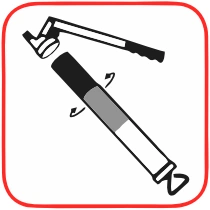 Cartridge Loading
14 oz. (400 g)
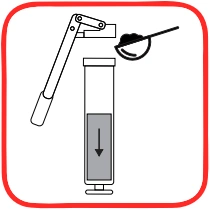 Bulk Loading
15 oz. / 500 cc
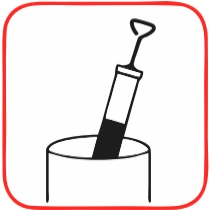 Suction Filling
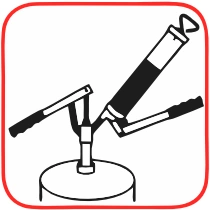 Filler Pump
How the S-741 Works
The S-741 works in four stages: load, select mode, prime, and dispense. The mode-select step between priming and dispensing is the distinctive dual-mode workflow that sets the S-741 apart from single-mode lever grease guns.
- Load. Choose one of four loading methods. For 14 oz. (400 g) cartridge fill, retract and lock the plunger rod, unscrew the barrel at the head-to-barrel joint, peel the metal pull-tab off a standard DIN 1284 cartridge, insert nose-first, peel the plastic bottom seal, screw the head back on. For bulk pack, retract and lock the plunger, unscrew the barrel, dip the barrel mouth into a 5 kg, 15 kg, or 20 kg grease pail, pack grease firmly against the sidewalls with a scoop to fill the 500 cc reservoir. For suction fill, retract and lock the plunger with the barrel attached, dip the gun nose into an open grease container, release the plunger rod slowly. For filler pump fill, connect a hand-operated or pneumatic filler pump to the 1/8" BSPT inlet on the head. For full-barrel cleaning between grease-chemistry changes, unscrew the demountable bottom cap to access and flush the full barrel interior.
- Select mode. Before pumping, slide the mechanical mode switch on the gun body to the correct position for the service task. HP mode for stubborn zerks, clogged grease lines, frozen fittings in winter, crusted outdoor-exposed fittings, and any task where pressure (not volume) is the limiting factor. HV mode for fast fleet maintenance, large-bearing service, open-access multi-point greasing, and any task where output throughput (not peak pressure) is the limiting factor. The mode selector stays in the chosen position until manually changed; it does not reset between strokes. For mixed-fitting routes, set the mode once per fitting group and work through the group before switching again. Switching between modes should be done with the gun depressurised (no coupler connected or coupler released) to avoid stressing the internal mechanical-advantage linkage under load.
- Prime. Release the plunger rod from the side-slot lock so the extra-heavy follower spring compresses the grease column against the head. Crack the air bleeder valve a quarter turn to release trapped air, then pump the lever 3 to 5 full strokes with the coupler disconnected until grease flows cleanly from the nozzle without air bubbles. Close the bleeder valve. Prime in whichever mode is currently selected; the grease supply to the pump chamber is the same regardless of mode. First-use priming on a new gun may take 5-8 strokes because the internal cavity is empty; subsequent priming after cartridge changes typically takes 3-5 strokes.
- Dispense through the correct port. Connect the hydraulic coupler to a zerk fitting through the correct discharge port: top port with flexible hose for blocked-access or tight-angle fittings, front port with rigid steel extension for direct-access fittings. In HP mode, pump until fresh grease appears at the bearing seal or the lever resistance sharply increases; typical service uses 3-10 strokes at 0.6 g per stroke. In HV mode, pump until the bearing cavity shows fresh grease; typical service uses 2-5 strokes at 3.2 g per stroke. Stop immediately to avoid over-greasing. A 500 cc bulk fill covers roughly 40 typical fittings at 12 g each in HP mode, or approximately 150 large-volume fill cycles in HV mode where each fill uses 3.2 g per stroke.
The S-741 runs on lever power only: no battery, no compressor, no electrical supply. Engineered for professional users whose service workflow routinely spans both clogged high-pressure fittings and open-access high-volume bearings on the same route. For workshops that need a single-pressure 12,000 PSI flagship with Quadra-Cut Precision forged-steel head (no mode switch), the S-707 is the purpose-built alternative. For 10,000 PSI variable-stroke tight-access service with CNC aluminium head, the S-709 Heavy Duty is the variable-stroke comparison. For 10,000 PSI industrial/commercial fleet service with large prime-retention grease inlet, the S-738 Industrial/Commercial is the single-mode sibling on the same CNC aluminium head platform.
| Parameter | Value |
|---|---|
| Model | S-741 |
| Type | Manual Lever Action Grease Gun - Switch Model (High Pressure / High Volume) |
| Mechanism | Lever Type with Slide-Button HP/HV Mode Switch |
| HP (High Pressure) Mode Delivery | 0.6 g / Stroke (1 oz. / 47 Strokes) |
| HP (High Pressure) Mode Pressure | 12,000 PSI (830 bar) |
| HV (High Volume) Mode Delivery | 3.2 g / Stroke (1 oz. / 10 Strokes) |
| HV (High Volume) Mode Pressure | 2,000 PSI (130 bar) |
| Filling Options | Cartridge, Bulk, Suction, Filler Pump (4-way) |
| Cartridge Capacity | 14 oz. (400 g) DIN 1284 Euro-Cartridge |
| Bulk Capacity | 15 oz. / 500 cc (approximately 450 g) |
| Barrel Diameter (Ø) | 57.15 mm / 2-1/4" |
| Barrel Wall Thickness | 0.049" / 1.2 mm cold-drawn steel |
| Head Material | High-tolerance CNC machined aluminium die cast |
| Mode Switch | Slide-button mechanical selector (HP / HV) |
| Discharge Ports | Dual (top for flexible hose, front for rigid extension) |
| Barrel-to-Head Joint | Rolled threads (quick and easy reloading) |
| Non-Return Valve | Machined precision one-way valve |
| Air Bleeder | Yes (air release on head) |
| Bottom Cap | Demountable for easy barrel cleaning |
| Body Finish | Non-slip textured powder coating |
| Grip | Knurled barrel for non-slip grip |
| Thread Options | 1/8" BSPT / 1/8" NPT / M10 x 1 / Custom |
| Extension / Hose Size | 6" (150 mm) Steel Extension / 12" (300 mm) Flexible Hose / Both |
| Coupler | 4-Jaw hydraulic coupler with ball check (standard), locking coupler (optional) |
| Grease Grade Compatibility | NLGI 1, NLGI 2, NLGI 3 (lithium, calcium, aluminium complex, polyurea, moly-fortified EP) |
| Operating Temperature | -10°C to +80°C |
| Primary Market | Heavy-equipment fleet workshops, industrial plant maintenance, mixed-workflow professional service |
| Country of Origin | India (Made in Ludhiana, Punjab) |
| Certifications | ISO 9001:2015, CE, RoHS compliant |
| HS Code | 8205 |
| Warranty | 1 year against manufacturing defects |
| OEM / Private Label | Available (MOQ 1000 applies) |
Every S-741 ships ready to use with accessories included, in one of three kit configurations.
6" (150 mm) Steel Extension (front port)
4-Jaw Hydraulic Coupler
Instruction Manual
12" (300 mm) Flexible Hose (top port)
4-Jaw Hydraulic Coupler
Instruction Manual
6" (150 mm) Steel Extension (front port)
12" (300 mm) Flexible Hose (top port)
4-Jaw Hydraulic Coupler
Instruction Manual
R = Rigid Extension (front port)
F = Flexible Hose (top port)
RF = Rigid Extension & Flexible Hose both included (use both ports independently)
Kits are fully customisable. Additional couplers (locking, quick-release), sharp nozzle tips, pointed connectors, grease-gun nipple adapter kits, and switch-mechanism replacement parts can be included in the box on request. Contact us for custom kit configurations, carrying case options, and fleet-service dual-port private-label packaging.
Four engineering choices define the S-741 as the Switch Model 12,000/2,000 PSI dual-mode lever grease gun, positioned for mixed high-pressure and high-volume workflows.
The S-741's dual-mode HP/HV combination targets professional users whose service workflow spans both clogged high-pressure fittings and open-access high-volume bearings: heavy-equipment fleet workshops, industrial plant maintenance, and global industrial-supply distributor trade.
S-741 Variants & Related Models
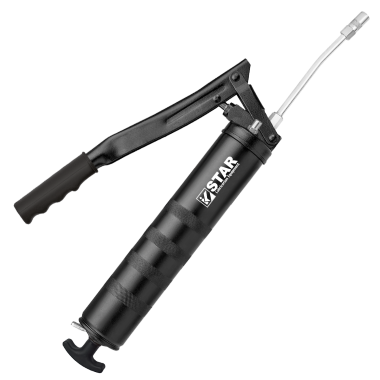
S-707 Quadra-Cut Precision Steel Head Heavy Duty Lever Action Grease Gun (12,000 PSI single-mode)
15 oz. / 500 cc
14 oz. (400 g) cartridge
Quadra-Cut Flagship (12,000 PSI)
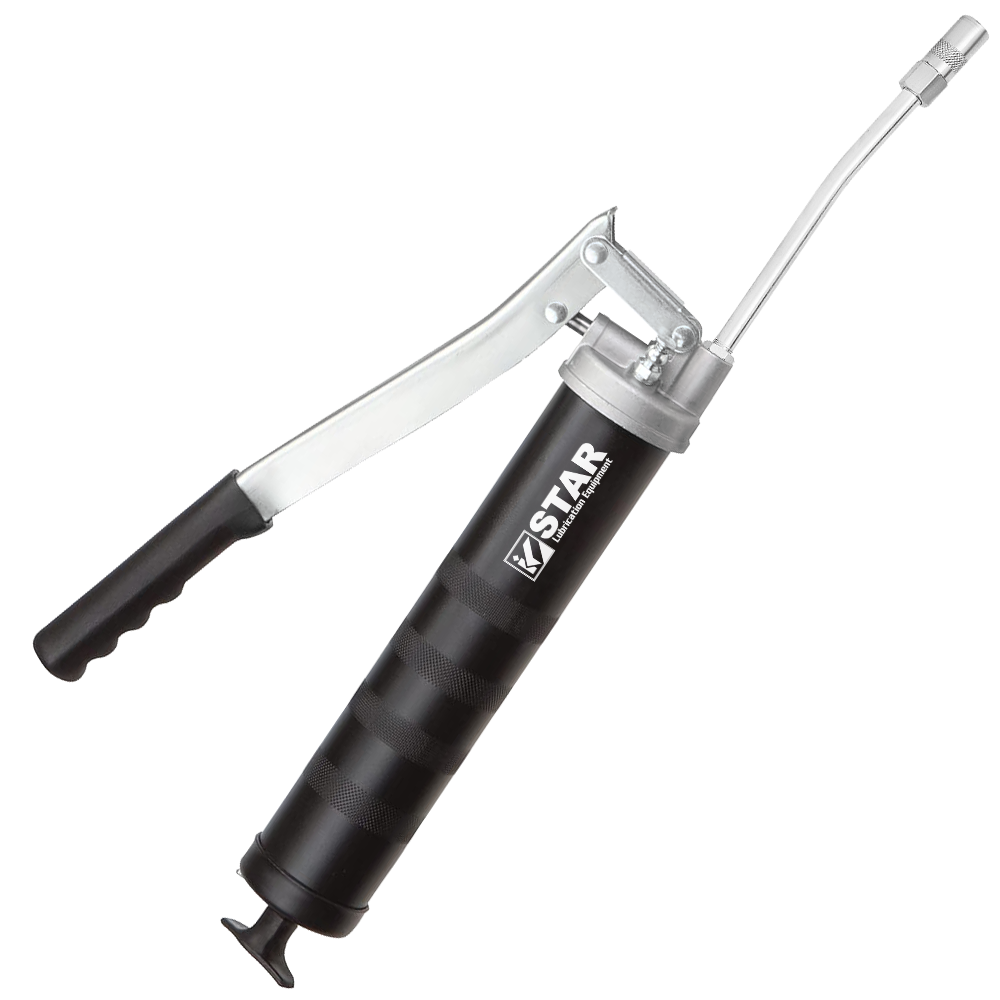
S-709 Heavy Duty Variable Stroke Aluminium Die Cast Head Lever Action Grease Gun (10,000 PSI variable stroke)
15 oz. / 500 cc
14 oz. (400 g) cartridge
Heavy Duty Variable Stroke
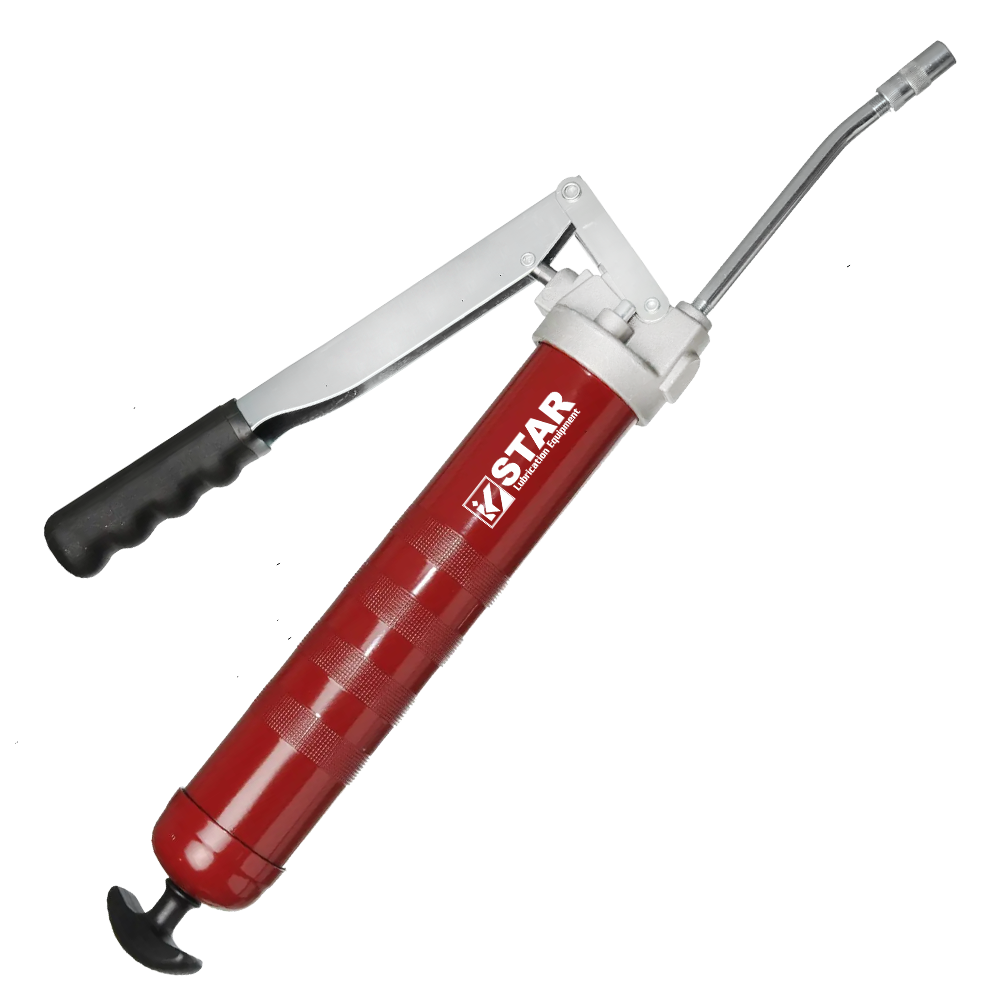
S-738 Industrial Commercial Lever Action Grease Gun (10,000 PSI single-mode, large prime-retention grease inlet)
15 oz. / 500 cc
14 oz. (400 g) cartridge
Industrial / Commercial (Prime Retention)
All Lever Action Grease Guns Full STAR lever action range
Full STAR lever gun range
Standard, wide-barrel, dual-piston, specialty
Browse full category
Compatible Accessories
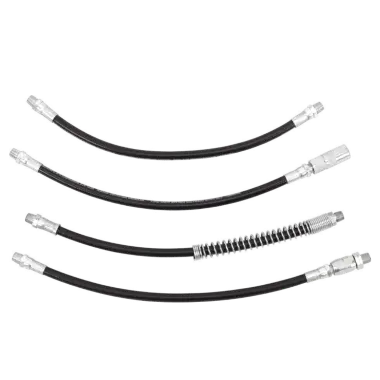
Flexible Hoses
Multiple lengths available
(12", 18", 24", 36")
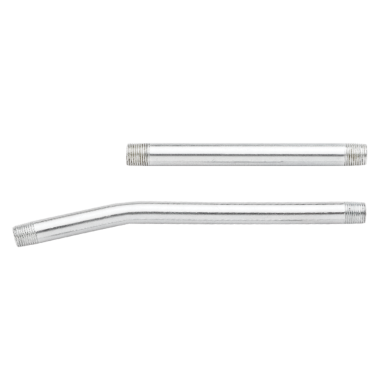
Steel Extensions
Multiple lengths available
(6", 18", 24" and more)
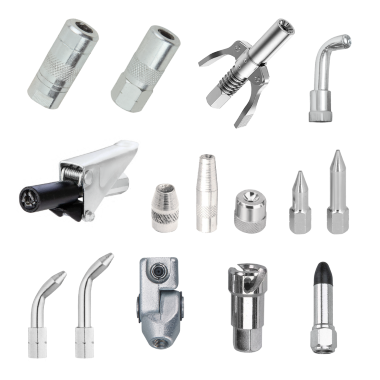
Couplers & Connectors
All types available
(hydraulic, 4-jaw, locking, sharp nozzle, quick-release)
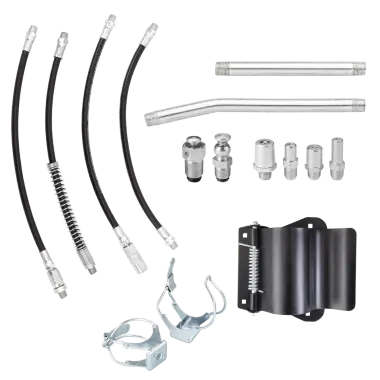
All Grease Gun Accessories
Full range available
(follower plates, seals, rebuild kits, switch-mechanism replacement parts)
Related Product Categories

Buying Guide: When the S-741 is the Right Choice
The S-741 is the dual-mode switch-model lever grease gun: 12,000 PSI HP mode for clogged fittings and 2,000 PSI HV mode for fast fleet-service. It is the right pick when the workshop's daily service workflow routinely spans both ends of the pressure-volume spectrum and the operator values single-tool versatility over single-mode optimisation. Our 2026 dual-mode grease gun buying guide covers the full HP/HV versus single-mode comparison.
Pick the S-741 for mixed HP/HV professional workflows
Heavy-equipment fleet workshops servicing both stubborn zerks and large open-access bearings, industrial plant maintenance covering mixed-pressure-profile fittings on the same route, construction-equipment service centres, amusement park and roller coaster ride maintenance, and lube-truck field service all match the S-741's dual-mode profile. The mechanical slide-button switch replaces two separate grease guns (one HP, one HV) in a single professional-grade unit, which saves tool-budget cost, storage space, and the productivity cost of switching between guns mid-service. For operators whose service workflow genuinely needs both pressure tiers across a typical day, the dual-mode engineering pays back through single-tool versatility.
Step up to the S-707 flagship for pure 12,000 PSI single-mode service
For workshops whose service workflow is predominantly high-pressure (most fittings are stubborn or crusted, HV mode would rarely be used), the S-707 single-mode 12,000 PSI flagship with forged-steel Quadra-Cut Precision head is the purpose-built alternative. Pure HP workflow doesn't need the S-741's HV mode; the S-707's single-mode design is simpler, has one less mechanism to maintain, and uses the Quadra-Cut Precision forged-steel head that survives concrete drops where aluminium die cast heads can crack. Pick the S-707 when HV mode would be unused capacity; pick the S-741 when the workflow genuinely spans both modes.
Compare with the S-709 variable stroke at 10,000 PSI
The S-709 Heavy Duty offers a similar dual-output capability but through a different engineering approach: variable stroke action modulates output continuously through lever-stroke length on every pump (short strokes build high pressure, full strokes deliver high volume), rather than a discrete mode switch between HP and HV. The S-709 variable-stroke approach is more responsive for fitting-by-fitting service pattern changes (each zerk can be served at a different stroke length), while the S-741 switch-model approach is more ergonomically simple for fitting-group service pattern changes (set mode once per group, work through the group). Both use the same CNC aluminium die cast head platform. Peak pressure: S-741 HP mode 12,000 PSI versus S-709 10,000 PSI maximum; HV output: S-741 3.2 g per stroke versus S-709 1 g per stroke maximum. The S-741 has higher peak pressure and higher peak volume; the S-709 has finer per-stroke modulation.
Compare with the S-738 Industrial/Commercial single-mode
The S-738 Industrial/Commercial is the single-mode 10,000 PSI sibling on the same CNC aluminium die cast head platform, optimised for industrial/commercial fleet service with a large prime-retention grease inlet. No mode switch, no variable stroke; designed for workshops whose service workflow is predominantly single-pressure high-volume (fleet depots, plant-maintenance routes, amusement park ride maintenance). The S-738's large prime-retention inlet reduces mid-route re-priming interruptions; the S-741's dual-mode switch extends the pressure range. Pick the S-738 when prime retention on long single-pressure routes is the priority; pick the S-741 when the workflow genuinely needs both pressure modes.
For industrial-supply distributor and OEM trade
The S-741 is the dual-mode flagship SKU for global industrial-supply distributor trade, professional-tool wholesale, dealer-workshop tool supply, and heavy-equipment fleet-tool distribution. Global export destinations include UK, Germany, France, Italy, Spain, Scandinavia, Russia, Turkey, Saudi Arabia, UAE Dubai, South Africa, Kenya, Nigeria, Brazil, Mexico, Indonesia, Philippines, Vietnam, Australia, and New Zealand. The switch-model engineering commands pro-tier margins versus single-mode 10,000-12,000 PSI alternatives because the dual-mode capability replaces two separate guns in one unit, which is the distributor value proposition when pitching to fleet and plant-maintenance buyers. Contact the STAR export team for dual-mode distributor pricing, custom colour-coded options, BSPT/NPT/M10 thread variants, MOQ 1000 private-label orders, switch-mechanism replacement-part supply arrangements, carrying case options, and mixed-container consolidation to Rotterdam, Hamburg, Antwerp, Felixstowe, and other industrial-supply hub ports. Made in Ludhiana, Punjab, India, exported to 27+ countries since 1980.
Frequently Asked Questions: S-741 Switch Model HP/HV Lever Action Grease Gun (12,000 PSI / 2,000 PSI)
What is the S-741 Switch Model and how does it replace two separate grease guns in one unit?
The S-741 is STAR's dual-mode HP/HV lever action grease gun with a mechanical slide-button selector that switches between high-pressure mode (12,000 PSI / 830 bar, 0.6 g per stroke) and high-volume mode (2,000 PSI / 130 bar, 3.2 g per stroke). A single S-741 covers both the service scenarios that would normally require two different grease guns in a professional workshop: clogged and stubborn fittings that need high pressure to clear (typically served by a dedicated 12,000 PSI gun like the S-707 flagship), and fast high-volume service on large open-access bearings (typically served by a dedicated high-output single-pressure gun). The switch mechanism engages or disengages an internal mechanical-advantage multiplier; the operator sets the mode for the service task and works the lever normally. For workshops whose workflow genuinely needs both pressure tiers daily, the dual-mode approach saves tool budget, storage space, and mid-service gun-swap productivity loss.
How does the slide-button mode switch work and when would I use HP vs HV mode?
The slide-button switch is a mechanical selector on the gun body that toggles the internal mechanical-advantage linkage between HP and HV configurations. No tool needed, positive click action, no electronic components. Use HP mode when pressure is the limiting factor, use HV mode when output throughput is the limiting factor. HP mode (12,000 PSI) is correct for: stubborn or crusted zerk fittings, clogged grease lines, frozen grease fittings in winter workshops, outdoor-exposed equipment fittings that have hardened, and any service task where the gun needs to build significant pressure to clear a restriction. HV mode (2,000 PSI) is correct for: fast fleet-service across multiple vehicles per shift, large-bearing service on industrial machinery, open-access multi-point greasing routes, and any service task where the bearing cavity takes significant grease volume at low-to-moderate internal pressure.
What pressure and output volume do the HP and HV modes deliver?
HP mode delivers 12,000 PSI (830 bar) maximum pressure at 0.6 grams per stroke output (1 oz. per 47 strokes). HV mode delivers 2,000 PSI (130 bar) at 3.2 grams per stroke output (1 oz. per 10 strokes). The HV mode's 3.2 g per stroke is approximately 5X the throughput of the 1 g per stroke standard used on most single-mode lever grease guns; the HP mode's 12,000 PSI matches the peak pressure of the S-707 flagship. The output-per-stroke difference reflects the mechanical-advantage trade-off: HP mode concentrates lever force on building pressure rather than moving volume (fewer grams per stroke), HV mode prioritises volume over pressure (more grams per stroke at lower peak PSI). Operators who switch between modes several times per shift adapt to the different stroke counts needed for each greasing task.
Can I use the HP mode to clear stiff, clogged, or frozen grease fittings?
Yes. HP mode is specifically designed for clogged, stubborn, and frozen fittings where lower-pressure guns cannot build enough force to clear the restriction. Typical HP mode use cases: old outdoor-exposed zerks on mining haul trucks, crusted farm-equipment fittings after wet-season storage, blocked grease lines on industrial conveyor bearings, frozen grease fittings in winter workshops where grease viscosity has effectively solidified in the fitting, and any service point where the standard 10,000 PSI tier is marginal. The 12,000 PSI peak pressure is the clearance margin for the hardest-to-clear fittings in professional service. If HP mode does not clear a fitting within a few pumps, the fitting itself is likely physically blocked rather than just crusted, and direct investigation (zerk removal, replacement, or service-shop cleaning) is needed rather than continued high-pressure pumping that risks bearing seal damage.
Is the HV mode the right choice for fast fleet and large-bearing service?
Yes. HV mode is the correct choice for high-volume service scenarios where output throughput is the primary workflow constraint: fast fleet-maintenance across multiple vehicles per shift, large-bearing service on industrial machinery where the bearing cavity takes significant grease volume, open-access multi-point greasing routes on farm tractors and earth-moving equipment, and amusement-park ride bearings with large grease capacity. At 3.2 g per stroke HV mode delivers roughly 5X the throughput of a standard 1 g per stroke single-mode gun, which saves measurable time across multi-point service routes. The 2,000 PSI peak pressure is more than adequate for clean open-access bearings (bearing seals typically resist up to about 1,500 PSI internal cavity pressure), so reducing peak pressure in HV mode does not compromise service effectiveness on open-access fittings. Use HP mode only when a fitting actively resists HV mode; most open-access professional-service fittings accept grease readily at 2,000 PSI.
How do I switch between HP and HV modes, and can I switch while greasing?
Switch modes by sliding the mode-selector button on the gun body to the desired position. The switch is intended to be operated between service tasks, not during active greasing. Best practice: release the coupler from the zerk fitting (depressurise the gun), slide the mode selector to the new position, re-engage the coupler, and continue. Switching while the coupler is pressurised puts load on the internal mechanical-advantage linkage and over time can stiffen the switch action or damage the mechanism. The switch stays in the chosen position until manually changed; it does not reset between strokes or after priming. For service routes that mix fitting types, the efficient approach is to service all HP-mode fittings first (mode set once, worked through the group) and then switch to HV mode for the remaining high-volume fittings, rather than switching back and forth on individual fittings.
Is the switch mechanism durable for daily professional use?
Yes. The switch mechanism uses mechanical components (no electronics, no adhesives, no thin plastic moving parts) rated for daily professional use across the service life of the gun. Typical switch-mechanism service expectations under daily professional use: thousands of mode-switch operations before noticeable wear, replaceable switch components available through the STAR spare parts catalogue if wear does develop, and routine maintenance limited to occasional cleaning with mineral spirits when grease contamination enters the switch-mechanism housing. Good practice: operate the switch with the gun depressurised, avoid forcing a stuck switch (investigate the cause instead; typically grease contamination that needs cleaning), and keep the switch housing clean during regular barrel cleaning cycles through the demountable bottom cap. For workshops running mixed grease chemistries through the same gun, flushing the barrel and switch-adjacent areas with mineral spirits between chemistry changes prevents cross-contamination deposits that could stiffen the switch action.
How do I clean and maintain the switch mechanism?
Routine maintenance: operate the switch through its full travel once a month even if the gun is not being used, inspect the switch housing during barrel cleaning for grease contamination, and clean with mineral spirits if the switch action becomes stiff. Cleaning procedure: depressurise the gun, unscrew the demountable bottom cap to access the barrel interior, wipe the switch-adjacent surfaces with a lint-free rag dampened with mineral spirits, operate the switch through its full travel several times to distribute the solvent through the mechanism linkage, wipe again with a dry lint-free rag, and reapply a light film of the gun's intended grease chemistry to the switch linkage bearing surfaces (not through the mechanism, just on exposed pivot points). Do not use aggressive solvents, penetrating oils, or compressed air; mineral spirits and a clean rag are sufficient. If the switch becomes permanently stuck or stiff despite cleaning, replacement switch-mechanism parts are available through the STAR spare parts catalogue.
What are the two discharge ports for on the S-741?
The S-741 head has two independent hydraulic outlets. The top port is designed for flexible hose service (used for greasing fittings in blocked-access, tight-angle, or inside-assembly locations where rigid extension cannot reach). The front port is designed for rigid steel extension service (used for regular greasing applications with direct line-of-sight to the zerk). The dual-port design lets the operator pick the correct outlet for each fitting without swapping the extension between service points, which reduces tool-swap interruptions across mixed-access service routes. Both ports use the same 4-jaw hydraulic coupler with ball check standard fitting, and both ports operate in both HP and HV modes; the mode switch controls the pump-chamber mechanical advantage regardless of which port is in use. Kit configurations (S-741/R, S-741/F, S-741/RF) determine whether the kit ships with rigid extension, flexible hose, or both.
Can 12,000 PSI in HP mode damage bearing seals?
Only if the operator continues pumping after the bearing cavity is full or if the fitting is completely blocked. Bearing seals typically fail at internal grease-cavity pressures of 500 to 1,500 PSI; the 12,000 PSI figure is the maximum pump pressure when the coupler outlet is fully blocked, not the steady-state pressure reaching the bearing. Actual pressure at the bearing depends on the fitting's flow restriction: a clean zerk on a healthy bearing passes grease at low pressure, the pump never reaches peak PSI unless the path is completely blocked. To prevent seal damage: stop pumping the moment fresh grease appears at the bearing seal or the lever resistance sharply increases. If a fitting will not accept grease within a few pumps in HP mode, investigate the fitting (remove, clean, or replace) rather than continuing to pump at peak pressure. Over-pressurising a blocked fitting in HP mode is the primary way to damage seals with the S-741; controlled pumping with attention to the lever feedback avoids this.
Can the S-741 cause a grease injection injury at 12,000 PSI?
Yes. HP mode builds the full 12,000 PSI peak pressure, which is higher than any other grease gun in the STAR range except the S-707 flagship. Above 7,000 PSI the likelihood of amputation from fluid injection injury escalates significantly if treatment is delayed. A pinhole in the hose or unseated coupler can drive grease through intact skin at 12,000 PSI; a ruptured hose can project grease at peak pressure across the entire rupture profile, significantly increasing exposure area. The initial wound looks like a tiny puncture and often does not hurt much initially; grease migrates along tissue planes and causes chemical damage that becomes visible as swelling, colour change, and infection over 24-72 hours. Go to an emergency department immediately for any suspected injection injury, brief the staff it is a high-pressure grease injection (not a simple puncture), and do not wait for pain to develop. HV mode at 2,000 PSI still carries injection-injury risk, though somewhat lower than HP mode; treat any injection-injury suspicion as a surgical emergency regardless of which mode was in use.
What PPE should I wear when using the S-741 in HP mode?
Mandatory: wraparound safety glasses (ANSI Z87.1+ impact-rated with side shields), nitrile chemical-resistant gloves, long sleeves, and closed-toe steel-capped shoes at minimum. Safety rules in HP mode: never point the coupler or flex hose at any body part or another person, keep the non-lever hand behind the coupler head during pumping, inspect the hose and coupler before each use for visible damage (cracks, bulges, stiffening, loose connections) as high-pressure 12,000 PSI work magnifies the consequence of a ruptured hose or unseated coupler, never test grease flow by pressing the coupler against skin or fabric, never use the gun near open flames, and do not operate the gun in confined spaces without adequate ventilation. The 12,000 PSI HP mode has the same PPE requirements as the S-707 flagship. Safe distance: keep bystanders at least 3 metres from the active greasing area when operating in HP mode, particularly during coupler-disconnect moments where any residual pressure releases through the nozzle.
How do I prime the S-741 and which mode should I prime in?
Prime the S-741 the same way as a standard lever grease gun: retract and lock the plunger rod, unscrew the barrel at the head-to-barrel joint, insert the 14 oz. (400 g) cartridge nose-first with both seals peeled or bulk-fill the 500 cc reservoir, screw the head back on, release the plunger rod. Crack the air bleeder valve a quarter turn to release trapped air, then pump the lever 3 to 5 full strokes with the coupler disconnected. Prime in whichever mode is currently selected; the pump chamber fills the same way regardless of mode. First-use priming on a new gun may take 5-8 strokes because the internal cavity is completely empty; subsequent priming after cartridge changes typically takes 3-5 strokes. If priming fails after 5 strokes: check the plunger rod is fully released, inspect the cartridge seating for air voids at the cartridge-head interface, and in cold weather allow the grease 5-10 minutes to warm to ambient before priming. The HV mode primes slightly faster than HP mode because each stroke moves more grease volume through the pump chamber; in cold weather or with stiff greases HV-mode priming is the recommended starting point.
How does the S-741 Switch Model compare to the S-709 variable stroke and the S-707 flagship?
All three target high-pressure professional service but through different engineering approaches. The S-707 flagship is a single-mode 12,000 PSI gun with forged-steel Quadra-Cut Precision head; optimal for workshops whose workflow is predominantly high-pressure and where the simpler single-mode construction and steel-head drop resistance pay back over the dual-mode versatility. The S-709 Heavy Duty uses variable-stroke action at 10,000 PSI on the CNC aluminium die cast head platform; output modulates continuously through lever-stroke length (short strokes build high pressure, full strokes deliver high volume), which is optimal for fitting-by-fitting service pattern changes. The S-741 uses discrete mode switching at 12,000/2,000 PSI on the same aluminium head platform; mode set once per fitting group, worked through the group with normal lever operation, optimal for fitting-group service pattern changes. Peak pressure S-741 HP mode 12,000 PSI equals S-707; variable-stroke S-709 tops at 10,000 PSI. Volume throughput S-741 HV mode 3.2 g per stroke exceeds both the S-707 and S-709 standard 1 g per stroke.
Does the S-741 accept standard 14 oz (400 g) cartridges and 4-way loading?
Yes. The S-741 uses the 57.15 mm worldwide-standard barrel bore and accepts 14 oz. (400 g) DIN 1284 Euro-Cartridge grease cartridges stocked across European, UK, North American, Asian, African, Middle Eastern, and Latin American grease supply chains. Full 4-way loading: 14 oz. cartridge, bulk pack from 5 kg / 15 kg / 20 kg pails, suction fill from open containers, and filler pump fill from shared depot reservoirs. Same cartridge platform as the rest of the STAR 14 oz./400 g lever-action range (including the S-707 flagship, S-709 Heavy Duty variable stroke, S-738 Industrial/Commercial, and S-736 European Model), so workshops standardising on 400 g cartridges can rotate guns across the range without changing cartridge supply. The demountable bottom cap makes between-chemistry barrel flushing faster than on non-demountable designs, supporting workshops that need to switch grease chemistries occasionally without cross-contamination.
Is the S-741 available for OEM and private-label orders?
Yes. OEM and private-label manufacture is available on the S-741 for global industrial-supply distributors, professional-tool wholesale trade, heavy-equipment fleet-tool distribution, and dealer-workshop tool-supply trade. Options include custom branding, packaging design for industrial-supply or commercial retail format, BSPT/NPT/M10 thread variants, custom colour-coded powder-coat finishes, carrying case options, and custom kit configurations per distributor agreement. MOQ 1000 applies as the baseline. Switch-mechanism replacement-part supply arrangements are included in OEM agreements for distributors running service-support programmes. Shipping is sea freight to Rotterdam, Hamburg, Antwerp, Felixstowe, Los Angeles, New York, Santos, Jebel Ali, Durban, Mombasa, Lagos, and other industrial-supply hub ports worldwide. Global export destinations include UK, Germany, France, Italy, Spain, Scandinavia, Russia, Turkey, Saudi Arabia, UAE Dubai, South Africa, Kenya, Nigeria, Brazil, Mexico, Indonesia, Philippines, Vietnam, Australia, and New Zealand. Contact the STAR export team for dual-mode distributor pricing, lead times, catalogue requests, and packaging specifications. Made in Ludhiana, Punjab, India, exported to 27+ countries since 1980.
Why Global Buyers Trust STAR
We at STAR have manufactured lever action grease guns in our ISO 9001:2015 certified workshop in Ludhiana, Punjab, India since 1980. The S-741 Switch Model HP/HV ships with full export documentation, multilingual manuals, and STAR dual-mode distributor partner programme documentation including switch-mechanism spare parts supply arrangements. Distinctive dual-mode SKU for global industrial-supply distributors targeting heavy-equipment fleet workshops, industrial plant maintenance departments, construction-equipment service centres, amusement-park ride maintenance programmes, and professional-tool distribution. Operator training videos and HP HV grease gun tutorial material are available through the STAR international supplier network and authorised distributor channels for workshop onboarding. STAR authorized distributor network covers 27+ countries with documented export experience across European, Middle Eastern, African, Latin American, Asian, and Oceania markets.