Industrial Funnel & Oil Funnel Manufacturer & Exporter - Funnels
We at STAR manufacture a complete range of industrial funnels and oil funnels in polypropylene plastic and galvanized steel. From standard 2" (50 mm) funnels for precision pouring to heavy-duty 12" (300 mm) garage funnels with built-in mesh strainer filters, our range covers automotive workshops, chemical plants, agricultural operations, laboratories and food processing environments.
Every polypropylene funnel is chemical-resistant, corrosion-proof and heat-tolerant up to 120 °C, handling petroleum products, acids, bases and most industrial solvents without degradation. Our anti-spill funnels feature contoured bodies and curved rims that prevent splashing during fast pouring. The galvanized steel funnel (FNL-ZN) provides impact resistance and spark-safe handling for heavy-duty fuel transfer. Available for OEM and private label supply with custom branding and packaging.
ISO 9001:2015 Certified | Exporting to 27+ Countries | OEM / Private Label Available
Our Range of Industrial & Automotive Funnels
Polypropylene and galvanized steel funnels for workshops, garages, factories and laboratories. Select a product to view sizes and specifications.
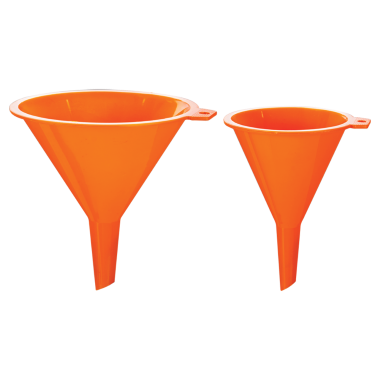
Funnels (Standard) - Polypropylene 2" to 10"
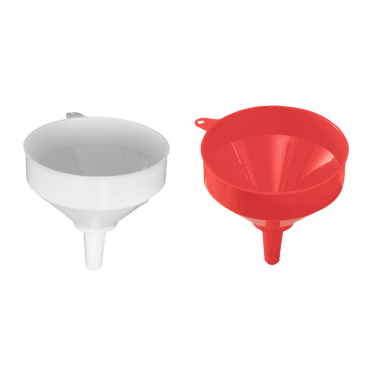
Funnels (Conical) - Straight High Rim 4" to 10"
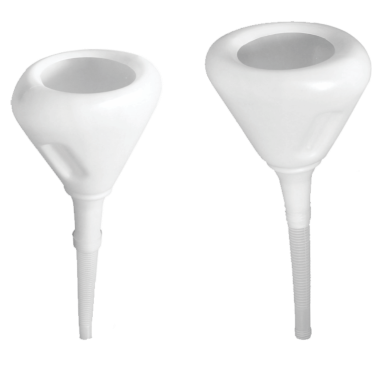
Anti-Spill Funnel - Curved Rim 6" and 9"
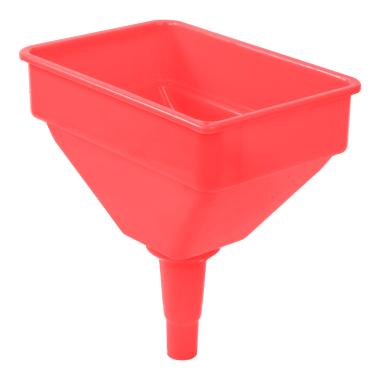
Garage Funnel - 12" Heavy-Duty with Optional Filter
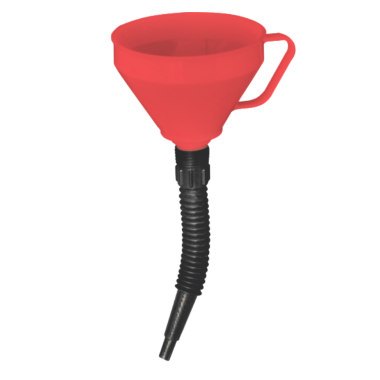
Funnel with Handle & Flexible Spout - Straight Rim 6"
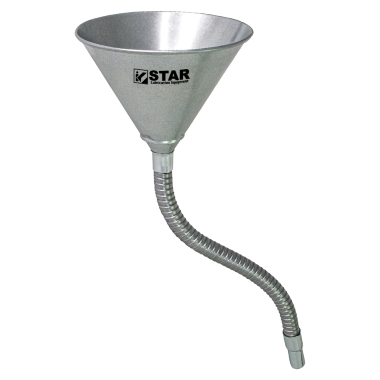
Galvanized Steel Funnel - 12" Heavy-Duty Metal
How to Choose the Right Industrial Funnel
By Application
For engine oil changes and fluid top-ups in automotive workshops, the 6" to 8" standard funnel or the 6" anti-spill funnel handles most tasks. For large-volume transfers (draining transmission fluid, filling bulk containers, pouring from 5-gallon cans), the 10" standard or 12" garage funnel with filter is the right choice. For tight engine bays and recessed oil filler caps, the funnel with handle and flexible spout reaches where rigid funnels cannot.
By Material
Polypropylene (PP) funnels suit 90% of workshop and industrial applications: they resist petroleum products, acids, bases and most solvents while remaining lightweight and corrosion-proof. The galvanized steel funnel (FNL-ZN) is the right match for environments where funnels get dropped, stepped on or exposed to extreme heat, and where spark-safe fuel transfer is required. For laboratory and food processing, polypropylene is BPA-free and food-safe.
By Size
Match the funnel mouth diameter to your fill port and flow rate. A 2" to 4" funnel suits narrow-neck bottles, small reservoirs and precision pouring. A 5" to 7" funnel handles standard oil filler necks on cars, motorcycles and light equipment. An 8" to 10" funnel manages high-volume pouring from large containers. The 12" garage funnel is designed for drum-to-equipment transfers and high-flow applications where speed matters.
Industries & Applications
Our industrial funnels serve fluid handling needs across every sector that transfers oils, fuels, chemicals or liquids:
- Automotive workshops: engine oil changes, transmission fluid, coolant, brake fluid, power steering fluid top-ups
- Agriculture: tractor hydraulic fluid, diesel fuel transfer, pesticide and herbicide handling
- Construction: heavy equipment hydraulic oil, fuel transfer for generators and compressors
- Manufacturing: CNC machine coolant, cutting fluid, lubricant dispensing at production lines
- Marine: boat engine oil changes, fuel transfer, bilge fluid handling
- Laboratories: precise chemical transfer, solvent dispensing, sample preparation
- Food processing: food-grade fluid transfer using BPA-free polypropylene funnels
- Fleet maintenance: multi-vehicle oil changes, bulk fluid dispensing across truck and bus depots
Why Choose STAR Funnels?
- 6 product lines covering every funnel application: standard, conical, anti-spill, garage (with filter), straight rim with handle, and galvanized steel
- Standard funnels in 8 sizes: 2", 3", 4", 5", 6", 7", 8" and 10" (FNL-2 to FNL-10) for precision to high-volume pouring
- Conical funnels in 5 sizes: 4", 6", 7", 8" and 10" (FNL-C series) with straight high rim for controlled flow
- Anti-spill design: curved rim and contoured body prevent splashing during fast pouring (6" and 9" sizes)
- 12" garage funnel with removable filter: catches debris, metal particles and contaminants before they enter equipment
- Flexible spout option: reaches recessed oil filler caps and tight engine bays where rigid funnels cannot fit
- Chemical-resistant polypropylene: withstands petroleum products, acids, bases and industrial solvents without degradation
- Galvanized steel option: impact-resistant, spark-safe and heat-tolerant for heavy-duty industrial environments
- External ribbing: eliminates air lock during pouring, ensuring smooth uninterrupted flow
- Custom OEM branding: logo printing, colour options and packaging for distributors worldwide
Polypropylene Funnel vs Galvanized Steel Funnel
Choosing between plastic and metal depends on your working environment, not on quality tier. Both are professional-grade tools engineered for different conditions:
Polypropylene (PP) funnels are lightweight, corrosion-proof and chemically inert. They handle petroleum products, acids, bases and most solvents without reacting. They will not rust, dent or contaminate fluids. Temperature range: -20 °C to +120 °C. Ideal for automotive workshops, laboratories, food processing and chemical plants.
Galvanized steel funnels (FNL-ZN) are heavier, rigid and impact-resistant. The zinc coating provides corrosion protection while the steel body withstands drops, crushing and extreme heat. Galvanized steel is spark-resistant, making it suitable for fuel transfer in environments where static discharge is a concern. Ideal for agricultural operations, outdoor use, heavy equipment maintenance and industrial fuel handling.
Complete Range of Funnels & Measuring Equipment
Our funnels are part of a complete plastic measures, jugs, funnels and equipment range. For precise fluid measurement before pouring, see our graduated measures (1 to 5 litres with flexible spouts) and measuring jugs (100 ml to 5,000 ml in clear polypropylene). For fluid transfer from barrels and drums, explore our barrel pumps. For precision oiling, browse our oil cans and hand pump oilers.
Looking for Bulk Orders or OEM Supply?
We at STAR manufacture industrial funnels in bulk for distributors and OEM partners worldwide. Custom sizes, colours, branding and packaging available. Funnels ship nested to reduce freight costs.
Request a Quote Become a PartnerExplore More from Our Range
Frequently Asked Questions: Industrial Funnels
What types of industrial funnels do you manufacture?
We manufacture 6 types of professional funnels: standard polypropylene funnels (FNL series, 2" to 10"), conical funnels with straight high rim (FNL-C series, 4" to 10"), anti-spill funnels with curved rim (FNL-B series, 6" and 9"), garage funnels with optional filter (FNL-G, 12"), funnel with handle and flexible spout (6"), and galvanized steel funnel (FNL-ZN, 12"). Each type is engineered for specific fluid transfer applications, from precision laboratory pouring to high-volume automotive oil changes.
What size funnel do I need for an oil change?
For standard car oil changes, a 6" to 8" funnel handles most oil filler necks comfortably. If your vehicle has a recessed or angled oil filler cap (common on modern engines with tight engine bays), the funnel with handle and flexible spout reaches where rigid funnels cannot. For topping up small reservoirs like power steering or brake fluid, a 3" to 4" funnel provides precision. For large-volume pours from 5-gallon containers, the 10" standard or 12" garage funnel prevents overflow.
What is the difference between standard and conical funnels?
Standard funnels (FNL series) have a traditional wide-mouth shape with a gradual taper to the spout, suitable for general-purpose pouring. Conical funnels (FNL-C series) have a straight high rim and a more pronounced cone angle, which directs fluid flow more precisely and reduces splashing. The high rim on conical funnels also provides greater capacity before overflow. Conical funnels are preferred for laboratory, chemical and controlled-flow applications where splash prevention matters.
How does external ribbing eliminate air lock in a funnel?
External ribbing creates small channels between the funnel spout and the container neck, allowing air to escape upward while fluid flows downward. Without these channels, the fluid seals against the container opening and creates a vacuum (air lock) that slows or stops flow entirely. You see this as "glugging" when pouring. Ribbed funnels maintain smooth, continuous flow even when the spout fits tightly into the fill port. This is especially important for high-viscosity fluids like gear oil.
Can I use a polypropylene funnel for gasoline and diesel fuel?
Polypropylene is chemically resistant to gasoline, diesel, kerosene and most petroleum fuels. The material will not degrade, soften or leach chemicals into the fuel. However, when transferring flammable liquids, ensure proper ventilation and consider static discharge risks. Polypropylene is non-conductive, so it cannot be grounded like a metal funnel. For fuel transfer in environments where static sparks are a concern (dry conditions, high-flow rates), our galvanized steel funnel (FNL-ZN) provides a spark-safe alternative.
What is an anti-spill funnel and how does it prevent splashing?
An anti-spill funnel has a specially contoured body and curved rim that catches fluid riding up the funnel walls during fast pouring, directing it back into the centre. Our FNL-B series comes in 6" (1.7 litre capacity) and 9" (3 litre capacity). The curved rim acts as a splash guard, preventing oil or fluid from escaping over the edge even when pouring quickly or at an angle. This is essential for oil changes where spills create slip hazards and waste expensive fluids.
Should I choose a plastic funnel or a galvanized steel funnel?
For most automotive and workshop applications, polypropylene is the better choice: it is lighter, chemical-resistant, corrosion-proof and will not contaminate fluids. Choose galvanized steel (FNL-ZN) when the funnel will be dropped regularly, exposed to extreme heat, used outdoors in harsh weather, or used for fuel transfer where spark resistance matters. Steel funnels are heavier and can dent, but they withstand physical abuse that would crack a plastic funnel. Both materials handle petroleum products safely.
Are polypropylene funnels safe for use with acids and chemicals?
Polypropylene resists most acids (hydrochloric, sulfuric at moderate concentrations, phosphoric), bases (sodium hydroxide, potassium hydroxide) and organic solvents. It is one of the most chemically inert plastics available. However, concentrated nitric acid, chlorosulfonic acid and some aromatic solvents at elevated temperatures can degrade polypropylene. For highly aggressive chemicals, verify compatibility before use. Our funnels are widely used in chemical plants and laboratories for routine acid and solvent transfer.
What is a garage funnel with filter and when do I need one?
Our 12" garage funnel (FNL-G-12F) includes a removable mesh strainer screen that catches debris, metal particles, dirt and contaminants before they enter your equipment. Use it when recycling or transferring used oil, pouring from containers that may have collected sediment, or filling equipment in dusty outdoor environments. The filter is removable for cleaning. Also available without filter (FNL-G-12) for clean fluid applications where maximum flow rate is the priority.
Can I reuse the same funnel for different fluids?
You can, but dedicated funnels for each fluid type prevent cross-contamination that can damage equipment. Mixing incompatible fluids (even trace amounts left in a funnel) can cause chemical reactions, seal degradation or reduced lubricant performance. For example, brake fluid residue in a funnel used for engine oil can damage engine seals. At minimum, thoroughly clean and dry the funnel between different fluid types. For professional workshops, colour-coded dedicated funnels are the safest practice.
How do I clean an oil funnel after use?
Rinse with warm soapy water immediately after use, before oil residue dries and hardens. For stubborn oil buildup, use a degreaser spray or solvent wipe. Polypropylene does not absorb oil, so residue sits on the surface and cleans off easily. Avoid abrasive scrubbers that scratch the surface (scratches trap contaminants). For funnels used with chemicals, flush thoroughly with clean water. Air-dry completely before storing to prevent moisture-related contamination.
How do I prevent a funnel from tipping over when pouring?
Use a funnel with a handle (like our straight rim funnel with handle) for one-handed stability, or choose a size where the spout fits snugly into the fill port. For freestanding use, place the funnel on a flat surface around the fill port. Anti-spill funnels with contoured bodies sit more securely than standard funnels. For hands-free operation on vehicles, some mechanics use a clip or holder to secure the funnel to the oil filler neck while pouring from a large container.
What is the heat resistance of polypropylene funnels?
Polypropylene funnels withstand continuous temperatures up to 120 °C (248 °F) without softening or deforming. This covers hot engine oil (typically 80-100 °C when drained), hot coolant and most workshop fluid temperatures. Below -20 °C, polypropylene can become brittle, so avoid dropping funnels in freezing conditions. For applications involving temperatures above 120 °C, use our galvanized steel funnel which handles significantly higher heat.
Do your funnels ship nested to save on freight?
Yes. Our polypropylene funnels are designed to nest inside each other, significantly reducing shipping volume and freight costs for bulk orders. A carton of 50 nested funnels occupies a fraction of the space that individually packed funnels would require. This is a key advantage for distributors importing container loads. Custom packaging configurations are available for OEM orders.
Can I use a polypropylene funnel for food-grade applications?
Polypropylene is BPA-free and approved for food contact in most countries. Our funnels are made from virgin polypropylene that does not leach chemicals or absorb flavours. However, once a funnel has been used for oils, chemicals or fuels, it should never be reused for food applications regardless of cleaning. Dedicate separate funnels for food and non-food use. For food processing facilities, we can supply funnels in food-safe colours with traceability markings.
What industries use industrial funnels?
Our funnels serve automotive workshops (oil changes, fluid top-ups), manufacturing plants (CNC coolant, cutting fluid), agriculture (tractor hydraulic fluid, diesel, pesticides), construction (heavy equipment fuel and lubricant), marine (boat engine service), laboratories (chemical transfer), food processing (food-grade fluid handling) and fleet maintenance depots (multi-vehicle service). The anti-spill and filter variants are particularly popular where cleanliness and contamination prevention are priorities.
Do you offer OEM funnel manufacturing with custom branding?
Yes. We provide full OEM and private label manufacturing for all funnel types with custom logo printing, colour options, sizing and packaging. We supply distributors and industrial buyers across 27+ countries. Minimum order quantities are flexible depending on the product line. Visit our OEM partnership page for details on bulk orders, lead times and export supply terms.