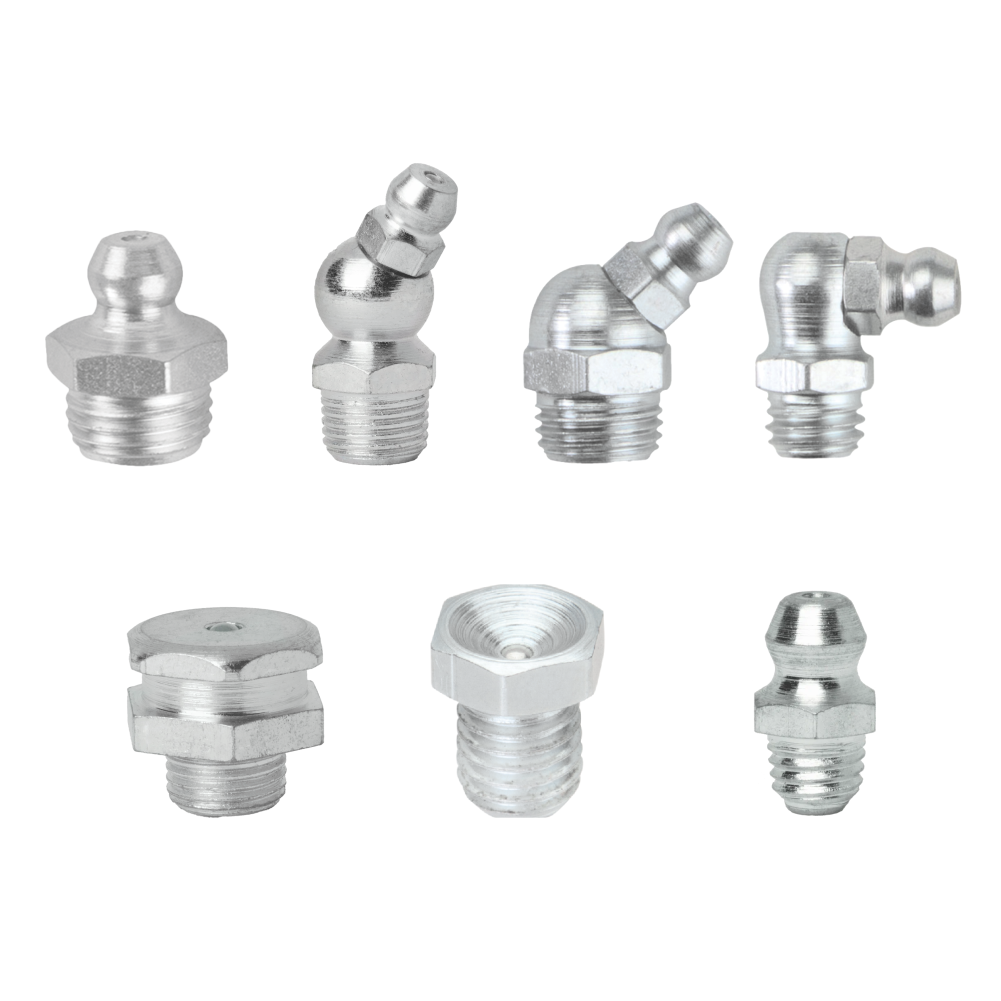


S-GN Series Grease Nipples (Grease Fittings / Zerk Fittings)
STAR Grease Nipples are precision-engineered lubrication fittings manufactured to SAE J534 and DIN 71412 specifications. Each fitting features a spring-loaded ball check valve that allows grease in under pressure while preventing contaminants from entering the bearing or joint.
Heat treated to a minimum Rockwell 15N hardness of 83 with a case depth of 0.005" (0.13 mm) to 0.009" (0.23 mm), these fittings resist deformation from repeated coupler engagement across thousands of greasing cycles.
Available in EN-1A carbon steel (zinc plated, 72+ hours salt spray resistance), 303 stainless steel for marine and food-processing environments, and brass for corrosive chemical applications. Zinc plating thickness conforms to 0.0002" (5 microns) per SAE J534.
We at STAR supply these fittings to automotive workshops, agricultural equipment fleets, construction machinery operators and industrial maintenance teams across 27+ countries. Available in UNF, NPT, BSP and metric threads from M6 to M16.
Quality Features
- SAE J534 heat treatment: greasing end hardened to minimum Rockwell 15N 83 for coupler engagement durability.
- Case depth 0.005" to 0.009" (0.13 mm to 0.23 mm) per SAE J534 specification for wear resistance.
- Spring-loaded ball check valve: heat-treated springs for extended life; prevents contaminant ingress and grease backflow.
- Zinc plating 0.0002" (5 microns): guaranteed 72+ hours salt spray life to red rust, conforming to European plating standards.
- Precision threading: profile and dimensions accurately controlled to SAE, DIN, BS, JIS and IS standards.
- Multiple materials: EN-1A carbon steel (standard), 303 stainless steel (marine/food), brass (chemical environments).
- Full angle range: straight, 30°, 45° and 90° configurations for any access requirement.
- Head styles: standard hex, button head (flush mount), square head, double head (round and hexagonal).
How a Grease Nipple Works
A grease nipple (also called a zerk fitting or grease fitting) is a one-way valve that allows pressurised grease into a bearing, joint or pivot point while keeping dirt and moisture out. Understanding the mechanism helps you select the right type and troubleshoot blockages.
- Coupler engagement: The grease gun coupler locks onto the nipple head. The coupler jaws grip the hardened head surface (Rockwell 15N 83 minimum), forming a pressure-tight seal. Button head fittings sit flush with the surface for environments where protruding fittings get knocked off.
- Ball check opens: Grease pressure from the gun (typically 3,000 to 12,000 PSI) pushes the spring-loaded ball off its seat, opening the passage. Grease flows through the nipple body and into the bearing cavity or grease channel.
- Ball check closes: When the coupler is removed and pressure drops, the heat-treated spring pushes the ball back onto its seat. This seals the fitting against dirt, water and debris ingress, protecting the lubricated component between service intervals.
Angled fittings (45° and 90°) route the grease path around obstructions, allowing coupler access where a straight fitting would be blocked by adjacent components. The internal ball check mechanism is identical across all angles.
| Specification | Value |
|---|---|
| Product Type | Grease Nipple / Grease Fitting / Zerk Fitting / Lubricating Nipple |
| Standards Compliance | SAE J534, DIN 71412, BS, JIS, IS |
| Material (Standard) | EN-1A Free-Cutting Carbon Steel |
| Material (Marine/Food) | 303 Stainless Steel (V2A) |
| Material (Chemical) | Brass |
| Surface Treatment | Zinc Plated, 0.0002" (5 microns) thickness |
| Salt Spray Resistance | 72+ hours to red rust (zinc plated variants) |
| Head Hardness | Minimum Rockwell 15N 83 (SAE J534) |
| Case Depth | 0.005" (0.13 mm) to 0.009" (0.23 mm) |
| Ball Check Valve | Heat-treated spring, one-way flow |
| Thread Standards (Imperial) | 1/4"-28 UNF, 1/8" NPT, 1/8" BSP, 5/16"-32 UNF, 3/8" UNF, 3/8" BSP |
| Thread Standards (Metric) | M6x1, M8x1, M8x1.25, M10x1, M10x1.25, M10x1.5, M12x1, M12x1.25, M12x1.5, M12x1.75, M16x1.5 |
| Angles Available | Straight (0°), 30°, 45°, 90° |
| Head Styles | Standard Hex, Button Head (Flush), Square Head, Double Head (Round), Double Head (Hexagonal) |
| Special Types | With Extension Pipe, Long Neck, Bell Crank Adapter, Drive-In |
| Plating Standard | Conforms to relevant European standards |
| Country of Origin | India |
| Certifications | ISO 9001:2015 |
| Packaging | Bulk (bags/boxes), Assortment Kits, Custom OEM packaging |
| OEM / Private Label | Available (custom logo, packaging, specifications) |
STAR grease nipples are available in over 30 configurations spanning imperial and metric threads, multiple angles, and specialist head styles. The table below shows our standard range; custom sizes and thread pitches are manufactured to order.
| Size | Available Types (Straight / 45° / 90°) | UNF | NPT | BSP | Metric |
|---|---|---|---|---|---|
| 1/4" | Straight | ✔ | ✔ | ✔ | - |
| 1/4" | 45° / 90° | ✔ | ✔ | ✔ | - |
| 1/4" Button Head | Flush mount | - | - | - | ✔ |
| 1/8" | Straight | - | ✔ | ✔ | - |
| 1/8" | 30° / 45° / 90° | - | ✔ | ✔ | - |
| 1/8" Button Head | Flush mount | - | - | - | ✔ |
| 1/8" Double Head Round | 45° / 90° | - | - | ✔ | - |
| 1/8" Double Head Hex | 45° / 90° | - | - | ✔ | - |
| 1/8" Square | 45° / 90° | - | - | ✔ | - |
| 1/8" with Extension Pipe | 45° / 90° | - | - | ✔ | - |
| 5/16" | Straight / 45° / 90° | ✔ | - | - | - |
| 3/8" | Straight / 45° / 90° | ✔ | - | ✔ | - |
| M6x1 | Straight / 45° / 90° | - | - | - | ✔ |
| M8x1 / M8x1.25 | Straight / 45° / 90° | - | - | - | ✔ |
| M8x1 Square | 45° / 90° | - | - | - | ✔ |
| M8x1 Hex with Nut | 45° / 90° | - | - | - | ✔ |
| M10x1 / M10x1.25 / M10x1.5 | Straight / 45° / 90° | - | - | - | ✔ |
| M10x1 Button Head | Flush mount | - | - | - | ✔ |
| M10x1 Hex with Nut | 45° / 90° | - | - | - | ✔ |
| M12x1 to M12x1.75 | Straight / 45° / 90° | - | - | - | ✔ |
| M16x1.5 | Straight / 45° / 90° | - | - | - | ✔ |
| M16x1.5 Long Neck | Straight | - | - | - | ✔ |
| Bell Crank Adapter | With Nipple | - | - | - | ✔ |
Custom thread pitches, non-standard angles, and special materials (304 SS, 316 SS, copper) manufactured to order. Contact us with your drawing or specification for a quote.
Understanding grease nipple specifications helps you select the right fitting for your equipment and avoid premature failure or contamination issues.
STAR grease nipples serve every industry that relies on bearing and joint lubrication. The correct fitting ensures reliable grease delivery to critical wear points across all operating conditions.
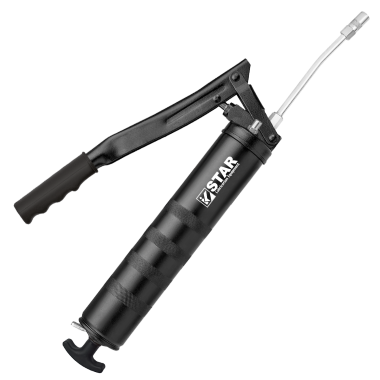
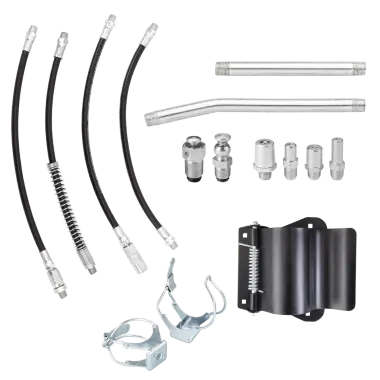
Compatible Accessories
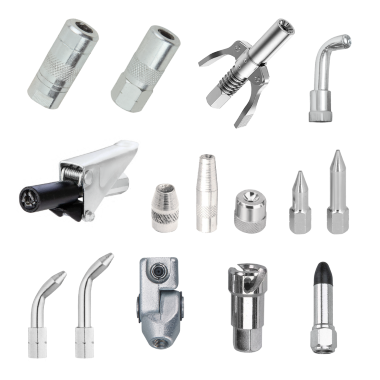
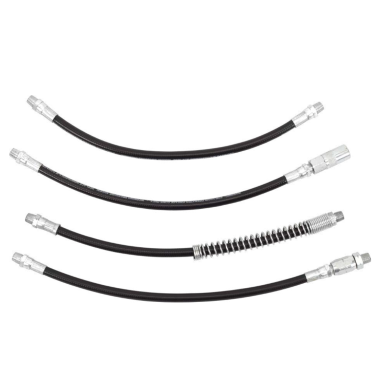
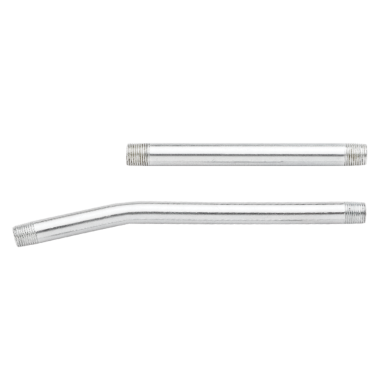
Related Product Categories

Buying Guide: Choosing the Right Grease Nipple
Selecting the correct grease fitting depends on thread standard, access angle, environment and equipment type. Here is how to match the right fitting to your application:
SAE vs Metric: Which Thread Standard?
North American equipment predominantly uses 1/4"-28 UNF and 1/8" NPT threads. European and Asian machinery uses metric threads (M6x1, M8x1, M10x1). Australian and UK equipment often uses 1/8" BSP. Always measure the existing fitting or check the equipment manual before ordering replacements. Using the wrong thread damages the tapped hole and creates a leak path that allows contaminants into the bearing.
Straight vs 45° vs 90°
Use straight fittings wherever the grease gun coupler can approach the fitting head-on without obstruction. Switch to 45° when adjacent components partially block access. Use 90° fittings when the grease point faces a wall, frame member or housing that completely prevents straight-line coupler engagement. Choosing the correct angle at installation eliminates the need for angled couplers or adapters during service.
Standard vs Button Head vs Drive-In
Standard hex-head fittings are the most common and easiest to install with a wrench. Button head (flush) fittings sit below the surface, protecting them from being knocked off in high-vibration or tight-clearance environments. Drive-in fittings press into a drilled hole without threading, used on thin sheet metal or where tapping is impractical. Square head fittings provide wrench flats in confined spaces where a hex wrench cannot rotate.
Material Selection
EN-1A carbon steel with zinc plating handles most industrial, automotive and agricultural applications. For marine environments, food processing, or any application with frequent washdown, 303 stainless steel prevents corrosion without relying on a sacrificial zinc layer. Brass fittings suit chemical environments where both steel and stainless may corrode. Always match the fitting material to the operating environment to prevent premature failure.
OEM and Bulk Buyers
We at STAR supply grease nipples in bulk quantities with custom packaging, private label branding and assortment kit configurations. Our standard MOQ is flexible for distributors and OEM equipment manufacturers. Contact our export team for pricing on bulk orders, custom thread specifications, or branded assortment kits with storage cases.
Frequently Asked Questions: Grease Nipples and Grease Fittings
What is a grease nipple and what is it used for?
A grease nipple (also called a zerk fitting, grease fitting or lubricating nipple) is a small one-way valve threaded into a bearing housing, joint or pivot point to allow pressurised grease delivery from a grease gun. The internal spring-loaded ball check valve opens under grease gun pressure (3,000 to 12,000 PSI) and closes when the coupler is removed, sealing the lubrication point against dirt and moisture. Every piece of rotating or sliding machinery with serviceable bearings uses grease nipples: automotive chassis joints, tractor pivot points, excavator pins, conveyor bearings and industrial equipment.
What is the difference between SAE and metric grease fittings?
SAE fittings use imperial thread sizes (1/4"-28 UNF, 1/8" NPT, 5/16"-32 UNF) while metric fittings use millimetre-based threads (M6x1, M8x1, M10x1, M12x1.5). They are not interchangeable because the thread pitch and diameter differ. North American equipment predominantly uses SAE threads. European, Asian and much modern agricultural machinery uses metric. Australian and UK equipment often uses BSP (British Standard Pipe) threads. Always identify the existing thread before ordering replacements; forcing the wrong thread damages the tapped hole permanently.
How does the ball check valve inside a grease nipple work?
The ball check is a spring-loaded steel ball seated against a machined bore inside the nipple body. When the grease gun coupler engages and applies pressure, the ball lifts off its seat, opening a passage for grease to flow through the fitting and into the bearing cavity. When the coupler is removed and pressure drops, the heat-treated spring pushes the ball back onto its seat, creating a seal that prevents dirt, water and debris from entering the lubrication point. This one-way mechanism is why grease stays inside the bearing between service intervals.
What thread sizes are most common for grease nipples?
The three most common grease fitting threads worldwide are 1/8" NPT (North America), 1/4"-28 UNF (North America, SAE standard) and M6x1 metric (Europe, Asia). In the UK and Australia, 1/8" BSP is standard. For larger equipment, M8x1, M10x1 and 1/4" NPT are common. STAR manufactures all standard thread sizes from M6 through M16 in metric, and 1/8" through 3/8" in imperial (UNF, NPT and BSP). Measure the existing fitting with calipers or a thread gauge before ordering replacements.
When should I use a 90° grease nipple instead of straight?
Use a 90° fitting when the grease point faces a wall, frame rail, housing or adjacent component that completely blocks straight-line coupler access. The 90° bend routes the coupler engagement point perpendicular to the thread axis, allowing the grease gun to connect from the side. Common applications include king pins behind steering knuckles, suspension bushings against frame rails, and pivot points inside enclosed housings. If partial obstruction exists but straight access is still possible with effort, a 45° fitting provides a compromise angle.
What is the difference between NPT and BSP grease fittings?
NPT (National Pipe Thread) is a tapered thread standard used in North America, while BSP (British Standard Pipe) is used in the UK, Australia, Asia and much of Europe. Both are 1/8" nominal size for grease fittings, but the thread angle differs: NPT uses a 60° thread angle while BSP uses a 55° angle. They are not interchangeable. Cross-threading an NPT fitting into a BSP hole (or vice versa) creates a poor seal and damages the threads. Always verify your equipment's thread standard before ordering.
How do I fix a blocked or clogged grease nipple?
Remove the fitting with a wrench, then clear the blockage using a thin wire or needle pushed through the ball check from the thread end. If hardened grease is the cause, soak the fitting in solvent (mineral spirits or brake cleaner) for 10-15 minutes to dissolve the blockage. Test by pressing the ball with a pin; it should move freely against spring pressure. If the ball is seized or the spring is broken, replace the fitting entirely. Before reinstalling, also clear the grease passage in the equipment using a wire or compressed air to ensure grease can reach the bearing.
Can I use any grease gun coupler on any grease nipple?
Standard hydraulic couplers and 4-jaw couplers fit all standard-head grease nipples regardless of thread size, because the coupler grips the external head diameter which is standardised. Button head (flush) fittings require a dedicated button-head coupler or adapter because the head sits below the surface. Pin-type fittings require a pin-type coupler. Always match the coupler type to the nipple head style. Thread size does not affect coupler compatibility; it only determines which tapped hole the fitting screws into.
What causes a grease nipple to break off during service?
The most common cause is over-torquing during installation, which creates stress fractures in the neck. Other causes include corrosion weakening the body (especially in outdoor or marine environments), impact damage from adjacent moving parts, and fatigue from repeated high-pressure greasing cycles on a fitting that was already cracked. To prevent breakage: install to the correct torque (hand-tight plus 1/4 turn for tapered threads), use anti-seize on the threads in corrosive environments, and replace any fitting that shows visible corrosion or deformation.
How often should grease fittings be replaced?
Replace grease nipples when the ball check no longer seals (grease leaks back out after the coupler is removed), when the head is deformed and the coupler cannot grip properly, or when corrosion has compromised the body. In normal service, a quality heat-treated fitting lasts 3-5 years or longer. In harsh environments (marine, mining, chemical exposure), inspect fittings annually and replace any that show corrosion, deformation or failed ball checks. Always replace fittings during major equipment overhauls as preventive maintenance.
What is DIN 71412 standard for grease nipples?
DIN 71412 is the German industrial standard that specifies dimensions, materials and performance requirements for grease nipples used in automotive and industrial applications. It covers straight (Form A), 45° (Form B) and 90° (Form C) configurations. STAR grease nipples conform to both DIN 71412 and SAE J534, ensuring compatibility with equipment manufactured to either standard. The DIN standard is widely referenced in European, Asian and Middle Eastern equipment specifications.
Should I use stainless steel or brass grease nipples for marine applications?
303 stainless steel is the standard choice for marine environments because it resists saltwater corrosion without relying on a sacrificial zinc coating that eventually wears through. Brass is suitable for chemical environments where even stainless steel may corrode (certain acids, chlorine-heavy washdown). For boat trailers, marine winches, davits and deck equipment that see regular saltwater exposure, stainless steel fittings eliminate the corrosion-related ball check failures that cause standard zinc-plated fittings to seize within 6-12 months in coastal conditions.
How do I measure the thread size of a grease nipple?
Use calipers to measure the major (outside) diameter of the thread, then use a thread pitch gauge to determine the pitch (threads per inch for imperial, or millimetre pitch for metric). Common measurements: 1/4"-28 UNF measures approximately 6.35 mm diameter with 28 threads per inch. M6x1 measures 6 mm diameter with 1 mm pitch. M8x1 measures 8 mm diameter. M10x1 measures 10 mm diameter. If the fitting is still installed, measure the hole diameter and match to a thread chart. STAR provides a grease fitting size chart with our assortment kits.
How do I install a grease nipple correctly?
Clean the tapped hole with a wire brush or tap to remove debris and old thread sealant. For tapered threads (NPT), apply a thin layer of PTFE tape or pipe sealant to the male threads. Thread the fitting in by hand until finger-tight, then tighten with a wrench: 1/4 turn past finger-tight for tapered threads, or to the specified torque for parallel threads. Do not over-tighten; excessive torque cracks the fitting body or strips the tapped hole. After installation, connect a grease gun and pump until fresh grease appears at the bearing seal to confirm the grease passage is clear.
What are the risks of high-pressure grease injection injury from a grease fitting?
Grease injection injury occurs when high-pressure grease (3,000 to 12,000 PSI) penetrates the skin, typically through a pinhole leak in a hose or at a fitting connection. The entry wound appears minor but grease spreads through tissue planes causing severe inflammation, infection and potential amputation if not treated within hours. Never place fingers over a grease nipple while someone else operates the gun. Never test for leaks by running a hand along a pressurised hose. If injection occurs, seek emergency medical treatment immediately and inform staff it is a high-pressure injection injury.
Why Global Buyers Trust STAR
We at STAR have been manufacturing grease nipples and lubrication fittings in our ISO 9001:2015 certified facility since 1980. Our fittings are shipped internationally with full export documentation and dedicated OEM support for distributors and equipment manufacturers.